

Introduction
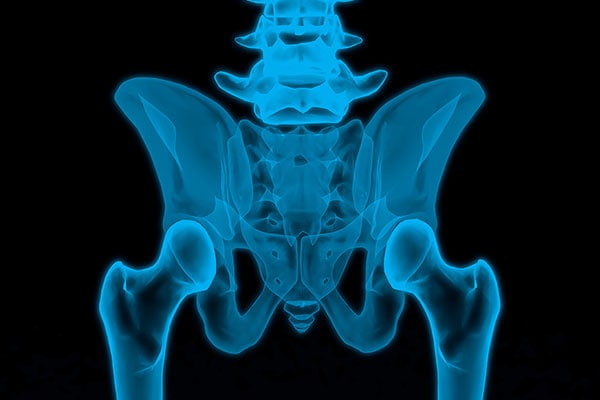
An anterior pelvic tilt is when your pelvis is rotated forward, which forces your lower spine to curve (lumbar lordosis). It’s often caused by prolonged sitting and can lead to other symptoms including lower back pain, stiffness, and a low range of motion around the hips. Individuals with severe anterior tilt will have an excessive lower back arch, with the bum sticking out and a stomach that protrudes, often creating the illusion of a larger stomach.
It’s important to remember that the position of your bones is usually determined by muscle activity, therefore it is essential to train muscles in the correct way to position your pelvis, lower back and hip joints in a stable neutral position. Muscles that are likely to be shortened are the rectus femoris, erector spinae and iliopsoas muscles. Weakened/inactive muscles are likely to be gluteus maximus, the hamstrings and the transverse abdominus and rectus abdominus.
Anterior pelvic tilt will not be corrected by any acute treatment, but by regular habitual movements and postural modifications. Today I am going to explain the 5 things that you need to stop doing IMMEDIATELY if you have anterior pelvic tilt. The reason I have put these first is that you are likely doing more damage by doing these 5 things and it’s important to eradicate them now.
Then we are going to explain the 5 best ways to correct anterior tilt of the pelvis.
5 Don’ts
1 Stretch the Hamstrings!
This may come as a surprise to many people, but the reality is this is a common mistake made by so many who have anterior pelvic tilt. The anterior tilt of the pelvis (higher posterior to anterior position), mean your hamstrings (the muscles at the back of the legs) are constantly under stretch. It’s very important to recognise the difference between a shortened muscle that requires lengthening and a muscle that is constantly under stretch. By stretching the muscle more you are in fact more likely to damage the hamstrings causing microtears along the muscle and tendon damage. The common mistake is understandable. The hamstrings have amongst the most nerve sensors in the body and the constant stretch we get in the hamstrings gives the false impression we should be stretching them more.
What we need to do is STRENGTHEN them!
2 Heavy loaded back squats!
Another misinformed and potentially dangerous consensus is that we should all be doing heavy bilateral back squats to strengthen our glutes. Whilst it is very important, we strengthen our glutes when we have anterior pelvic tilt, under no circumstances should you be loading heavy weight in a standard closed chain bilateral position (Both feet hip width apart in a symmetrical position). The anterior tilt of the pelvis means you will be already in a forward lean, and due to compensation to lift the bar placing more emphasis on the lower back to lift the weight. Combined often with limited ankle dorsiflexion and poor thoracic spine extension this is a recipe for disaster for many individuals and something I see regularly in gyms. Most individuals do not squat full range. They will ‘half squat’’ due to limited stability and mobility. A proper squat involves effective hip range of motion, decent thoracic extension, and ankle mobility capability. From my experience only 10-20% of individuals should be barbell back squatting with heavy loads. 0% should be barbell back squatting with severe anterior pelvic tilt.
Correct your biomechanics first with postural corrections, isolation exercises and mobility, then move onto other variations of squat with a split stance before correct assessment before taking on back squats.
3 Sit down for long periods!
Sitting down for long periods of time is the likely cause of anterior pelvic tilt and will only worsen the issue. The L shape position we take up for long periods of time at home or work is not only constantly shortening your hip flexors there is also constant lengthening and inactivation of the hip extensors. Furthermore, deactivation of the anterior core will further lead to a slump position which will have consequences up the kinetic chain causing back and neck issues.
My 2 best ways to rectify this is firstly to use a standing desk. This will prevent the constant shortening of the anterior hip muscles. With correct postural cotreatment and anterior core activation (see below ‘5 Do’s), your standing position will be more efficient, and your pelvis will be in a neutral safe position when you’re standing for long periods.
My second most effective way is to set an alarm every 15 minutes if you are going to be sitting down for lengthy periods. At every 15-minute interval perform a stretch or activation exercise that will engage the correct muscles.
4 Further Compress the Lower Back!
As well as poorly executed heavy back squats, there are several other exercises that are a waste of effort and ineffective when you have anterior pelvic tilt. The exercise list is often extensive in severe anterior tilt populations and the way to tell is simple. You will feel your lower back and no other muscles will be getting a workout. Common exercises that fall into this category are hip bridges and abdominal rollouts – due to the inability to function in a neutral spine position during the movement pattern. However, there are some great variations and simple alterations you can use that will promote posterior tilt during these exercises and hit the appropriate targeted muscles (glute max, rectus abdominus, transverse abdominus).
In more severe cases of anterior pelvic tilt, standing for long periods can cause an aching in the lower back and in some instances pain. To prevent this, you should regularly stretch and promote posterior tilt in a standing position (see #01 of the Do’s below)
5 Hip flexion abdominal exercises!
Individuals with anterior pelvic tilt will need to find a way to isolate their transverse abdominus and rectus abdominus, without engaging the rectus femoris and iliopsoas. Unfortunately, a visit to the captain’s chair doing leg raises or reverse floor abdominal curls is not going to achieve results. The already shortened and overworked muscles pulling down at the pelvis will be doing most of the work and you are just making the issue worse. Often you will feel these exercises working the upper legs and, in some instances, the lower back as the psoas major and minor pulls on the lumbar spine during dynamic pelvic extension and flexion. A shortened psoas tips your pelvis further forward, compressing the hip socket and preventing your leg from moving independently of your trunk. Your body, prevented from rotating at the ball-and-socket hip joint, then tries to compensate by forcing rotation at the low back or knees.
From my experience, the best way to treat anterior pelvic tilt is to use effective spinal flexion and extension movement patterns with a fixed hip position that will isolate the anterior core and suppress activation of the rectus femoris and psoas major and minor. Anti-rotation exercise with correct neutral spine and pelvis positioning are also very effective.
5 Dos
1 Correct your sitting posture (and laying and standing posture too!!!).
The first thing you can do to help improve posture and promote a neutral pelvis position is to become accustomed to the correct sit, stand and lay position. When at work, ensure your desk set up is correct, with the top of your monitor in-line with your eyes and the chair positioned that when you’re sitting your upper thighs are horizontal to the floor and your knees are bent at 90 degrees. You should also use an arm rest and back rest to ensure your elbows are at 90 degrees and your back is well supported. Engaging the lower abdominals by squeezing downwards will promote posterior tilt. DO NOT arch the lower back to get as tall as possible. This will promote anterior pelvic tilt.
When standing at your desk shoulders should be relaxed and like in the sitting position, the top of the monitor should be in-line with your eyes, and the keyboard and mouse should be positioned so that there is a 90-degree bend in the elbows. Promote posterior tilt by tucking bum under spine and engaging lower abdominals.
When laying on your back you will naturally have an excessive lower arch in your lumbar spine due to the pelvic tilt. A great way to correct this is to push the lower back down minimising the arch and engage the lower abdominals. Perform this movement 10 times when you wake up and as a warmup exercise before you do a workout.
A common theme across all three of these positions is the promotion of posterior pelvic tilt. This will not happen overnight, but regular abdominal activation and positional correction will initiate habitual positions that will lead to long term health and fitness benefits.
2 Isolation glute exercise.
Another muscle that is likely weak and needs specific attention when you have anterior pelvic tilt is the gluteus maximus. Unfortunately, the three general primary movement patterns that utilise the gluteus maximus (Hip extension, hip abduction and hip external rotation) rarely work the muscle in the anterior tilt population. An individual with anterior pelvic tilt is more likely to feel overworked in the lower back and upper thighs during classic hip extension (along with extreme stretching in the semitendinosus and semimembranosus muscles of the hamstring). During abduction exercises and during external rotation movements you will usually hit the hip abductors such as the piriformis that has become overworked and shortened. The correct way to perform exercises to maximise glute maximus activation, attenuate lower back compression and reduce hip flexor activation is outside the scope of this blog. For detailed information on how to perform the correct ways my details are at the bottom of this blog.
To get you started here are 3 great variations you can try:
– Hip bridge with head up.
This is a simple tweak to a hip bridge that will encourage posterior tilt.
– Reverse hyper extension with butt squeeze.
My favourite exercise to combat back pain, the reverse hyperextension can be performed at home off your bed or on a flat bench.
– Hip abductions with hip hyperextension and external rotation.
By performing the classic side lying hip raise with your back to a wall and pointing the foot upwards as you go up, you will encourage gluteus maximus to start working.
3 Transverse abdominus strengthening without rectus femoris and psoas activation.
I’m known for my gruelling abdominal workouts. This is not because I choose harder exercises than anyone else or work an individual for longer durations. The key is exercise selection and ensuring the correct exercise pattern is executed based on the characteristics of the individual. After discovering an individual has anterior pelvic tilt, it is essential to perform isolation anterior core exercises. You will find that if performed correctly with the right activation and breathing technique you will fatigue very quickly. For detailed information and coaching on how to perform the correct ways book in with me for an assessment and we can identify the areas we need to work on.
4 Unilateral exercise and mobilisation.
I have already discussed the limitations and potential dangers in performing many exercises in a feet symmetrical closed chain position if you have an anterior tilted pelvis. However, we do have great alternatives that will not only work the correct muscles, but also provide additional benefits. By splitting your stance and working on single leg strength (unilateral), you are creating a safer and highly beneficial movement pattern.
My ‘go to’ exercise is the sprinters lunge, which in essence is a split squat with a knee drive. This is a fantastic exercise for an individual with anterior pelvic tilt. Not only does it work the glutes on the standing leg, with the correct range of motion the moving leg will benefit from a great iliopsoas and rectus femoris stretch. At the same time, the single leg position means you are creating an unstable environment, thus fighting for stability, engaging the core and hip stabilisers.
5 Strengthen hamstrings
I have already established the importance of hamstring strengthening if you have an anterior tilted pelvis. However, it is important that you perform exercises that work these muscles in the posterior chain and not the already compressed and overworked muscles of the lower back. If you have access to a gym, isolation hamstring machines such as the seated or prone hamstring curl are good starting points. Swiss ball hamstring curls are also a good variation.
By David Griffin, call to book a session with me on 01732451979