


Weakness is Stiffness, Strength is Flexibility
A common uncertainty amongst some exercise practitioners is the difference between flexibility and mobility. And it’s a key point to understand when it comes to treating any restrictions in our range of motion.
The main difference is in the body structures that influence our movements and range of motion.
• Joint system – Capsule and Ligaments

• Muscles, Tendons and Fascia

While the capsule (first diagram) mainly influences the mobility of the joint and represents an important aspect of a correct movement as well as joint stability, here we want to focus on the contractile element: the muscle. Usually, we associate a restricted range of movement (ROM) such as stiff hamstrings, when stretching as a result of a tight muscle group and presume stretching is the only solution. We also tend to blame our inability to squat or lift something from the floor without curving the spine on the same stiffness. But this approach doesn’t consider a fundamental aspect of the muscle.
The Neuromuscular Control
Not only is our brain in control of our emotions and behaviour, it is also the key to our strength and flexibility. Our body’s natural state is one of homeostasis and its ultimate goal is to protect that state as best possible. The Central Nervous System (CNS) is in charge of all these protective functions and will always try to stop whatever it identifies as a danger to upsetting that homeostasis.
There are specific sensors within the muscles and tendons called proprioceptors that constantly inform the CNS of both the tension in the muscle and the speed of the lengthening within it (Fig 1 below). When the proprioceptors identify a tension considered unsafe, the CNS stops the muscle from further lengthening to prevent a strain.
We can see in Figure 1 how the ‘green’ ROM is considered safe for the hamstring muscle, so there will be no problem for a knee extension within that angle. As we move into the orange ROM the proprioceptors will signal an excessive tension and the CNS will block any further lengthening in the hamstrings.
fig. 1

fig. 2
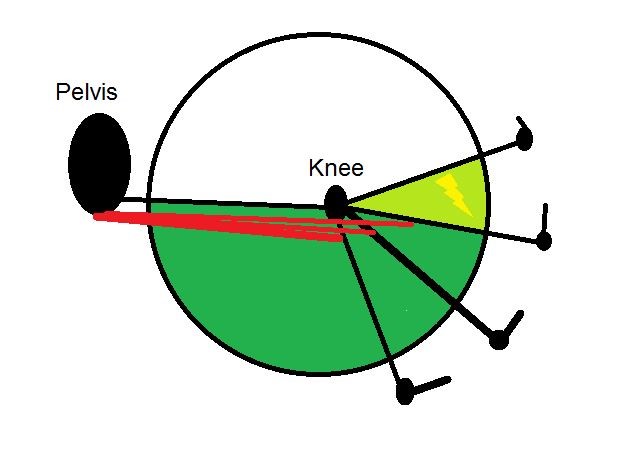
Let’s say in Figure 2 we start strengthening the muscle at the border of the ROM in Figure 1, the CNS will record that new higher level of tension in you muscle as safe and easy to control, and we will have no problem in extending the knee to the other positions.
In order to extend your ROM, you need to habituate your proprioceptors at those new tensions and make them into a range the CNS considers manageable. This way, they won’t be recognised as a risk to your muscles and tendons.
What to do
• Combine stretching and mobility to help build a solid base for correct movement patterns
• Every time you increase your ROM, make sure you can control and exert sufficient force in that new motion
• Proprioceptive Neuromuscular Facilitation (PNF) is a good method to adopt, as well as full ROM activities such as deep squats or the ‘good morning’
As always, if you’re not sure or have any questions after reading this post, grab me in the gym or let us know in the comments!
Fran
Personal Trainer, Sevenoaks