


Ok, now that I have enticed you with an offer of bountiful calories and an Adonis style physique, I have a confession to make. Maybe 12,000 is a tad unrealistic, hear me out before you grab your torch and pitch forks and start forming a lynch mob. Although I am not proud of this sensationalism, technically I didn’t lie. You can eat some serious grub and still keep them buns of steel.
Fried eggs, cheese sandwiches and chocolate chip pancakes.
This is the reality for some athletes. Michael Phelps, Olympic legend and 17-time gold medalist, claimed in an interview before the Beijing Olympics in 2008 that he consumed 12,000 calories a day. Although he later admitted this might be an exaggeration, there is no doubt he eats A LOT. His breakfast consists of foods such as fried eggs, cheese sandwiches and chocolate chip pancakes, Sound appealing? this is the same Olympics Usain bolt beat the world record for the 100 meters fuelled on Chicken McNuggets, it’s is not unheard of for some American footballers to have diets in excess of 6000 calories made up of burgers and other junk food, let’s be straight, most of us would happily settle for a third of this. but is it logical to believe we can just burn off what we eat? Can we out train a bad diet?
Yes, but CONTEXT is key, Michael Phelps is an Olympic athlete. During a peak training phase he can swim 80,000 metres a week. This is nearly 50 miles a week. Maybe I’m jumping the gun here, but I’m assuming you don’t have the desire and/or time to train like an Olympic athlete. This is his occupation, but the rest of us need to earn a crust doing more sedentary jobs. So, what do we burn throughout the day and how much does our general activity play a role in weight management?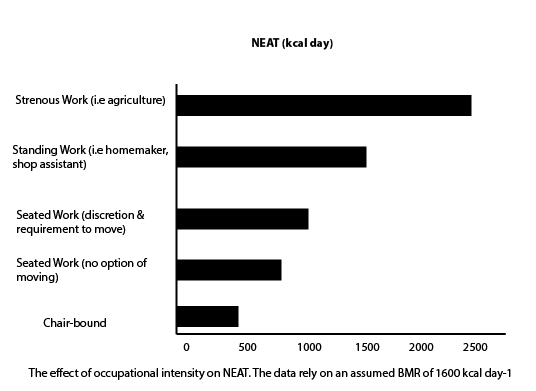
What this chart is showing is a thing called N.E.A.T: None Exercise Active Thermogenesis. A fancy way of saying everything you do that’s not recreational exercise. This ranges from fidgeting to walking up the stairs and varies massively depending on your occupation and other factors. For example, typing burns a measly 54 calories on average per hour.
Jobs such as working in a call centre or general office work, compared to jobs such as waiting, labouring and construction, vary as much as 2000 calories burned per day. Because simply put, they move more, and since getting a new job in construction is a tad extreme, if you are desk bound at work we need to perform some damage limitation. Here’s what you can do.
8 tips for increased N.E.A.T;
- Track your steps, 10,000 steps a day can burn as much as 500 calories. That’s 3500 per week.
- Get up from your desk every hour and go for a walk
- Stand up whilst talking on the phone.
- Set 1 hour aside after work to play with your kids when you get in from work, you will be surprised how strenuous it is building a pillow fort.
- Get off your train one stop earlier.
- Stop ordering your food shopping online, and get out of the house.
- Take the stairs.
- And last but certainly not least keep training hard. Apart from the obvious calorie burning effects, the fitter you are, the more energy you will have, the more you move, the more likely you are to take part in physical activities. And since exercise also give you a endorphin rush it will perk you up and when you’re happy you tend to be more active. Win win.
It can be helpful to increase activities when dieting to offset increases in calories due to social situations like parties and family events. But if you are serious about building a better physique you’re going to need to train and lower calories at some point realistically. If you want to out-train a bad diet it is possible but not advisable, 500 calories are a helluva lot easier to eat then they are to burn off. I must hold my hands up it is a lot easier for me, I work in a gym.
Darren Holness
Better Body Group, Sevenoaks